
Lyon County Arrest History
The Lyon County Sheriff provides primary local law enforcement for Rock Rapids, George, Inwood, Alvord, Doon, Larchwood, Lester, Little Rock, and the county's unincorporated communities. That broad jurisdiction means residents should not search for separate city police booking sites. Iowa State Patrol, DNR conservation officers, Iowa DCI agents, and federal officers may also make arrests that lead to a Lyon County jail entry.
The agency that made the arrest owns the underlying narrative report. Lyon County jail staff own the local intake and custody facts. The Clerk creates a court case only if charges are filed. Iowa DCI receives qualifying fingerprint-supported data for the statewide criminal-history layer. These records can differ in wording, timing, and legal effect.
The Sheriff's published organization separates law enforcement, dispatch and communications, and jail and detention work. That split is another reason to name the exact Lyon County arrest record when calling. It helps staff route the request to the unit that holds it.
Lyon County Sheriff Arrest Records
The Sheriff does not advertise a separately named records division, online request portal, local form, copy fee, or fixed response time. Use the agency itself at the Lyon County Law Enforcement Center, 410 South Boone Street, Rock Rapids, IA 51246. The main line is 712-472-8300, the jail line is 712-472-8356, and the fax number is 712-472-2303.
A request under Iowa Code chapter 22 should name the event date and time, place, agency, report number when known, exact record requested, preferred format, and a reply channel. Ask for a cost estimate before reproduction. The official Sheriff page confirms the headquarters, jurisdiction, and contact structure.
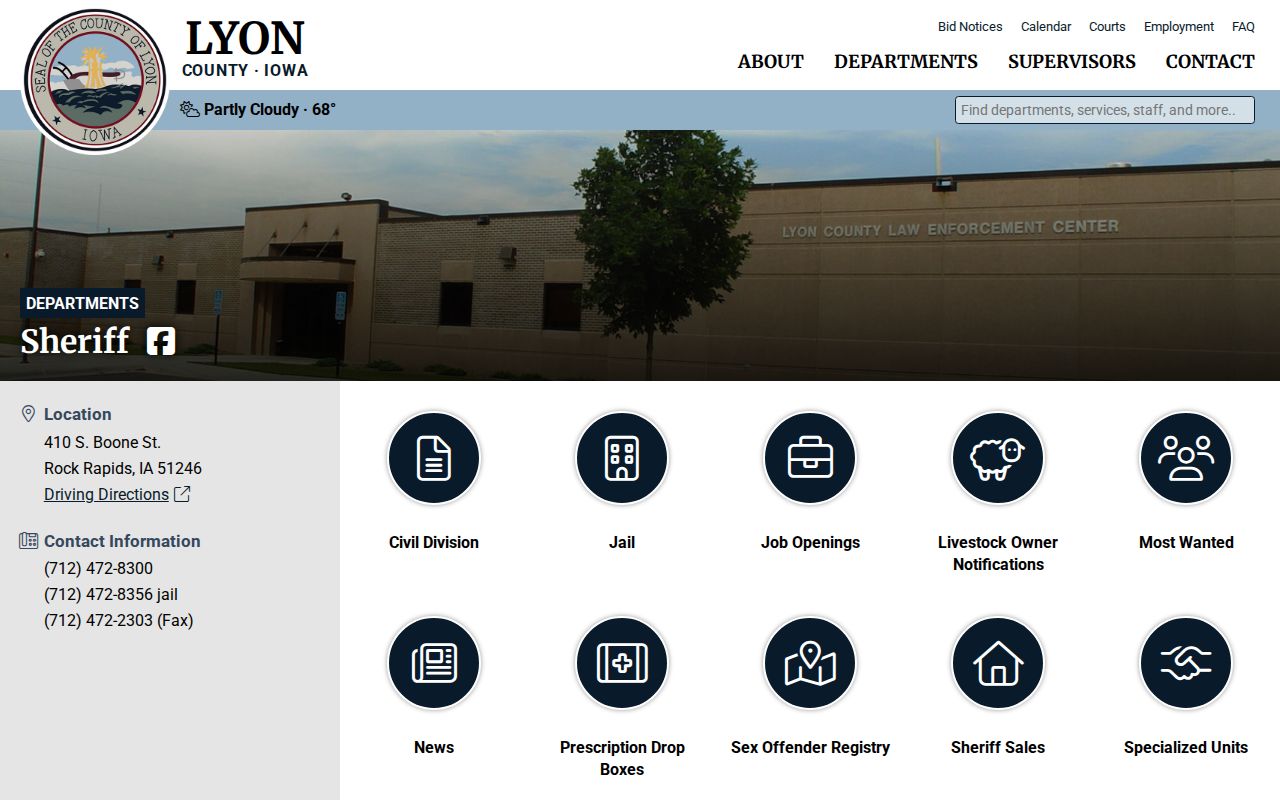
The Sheriff channel is the right local fallback when a public PDF provides too little detail.
Lyon County Sheriff and Jail
410 S. Boone St.
Rock Rapids, IA 51246
Sheriff: 712-472-8300
Jail: 712-472-8356
Jail staffed 24 hours
Looking Up Lyon County Arrests
The strongest Lyon County arrest lookup uses the record that matches the question. The arrest PDF is useful for a recent police event. The current-inmate PDF answers whether a person remains in local custody at its snapshot time. A court search shows filed charges and later results. The state check serves a different, statewide purpose and has its own authorization limits.
- Inspect the Sheriff's official Arrest PDF and note its update date. Then check Current Inmates for continued custody, charge rows, and bond entries.
- Search the Sheriff News archive for an official incident release, which may add context but is not the full report.
- Allow for court intake, then search Iowa Courts Online with Lyon selected to find filed charges, hearings, and the final disposition.
- Call 712-472-8356 for unclear custody status. Ask the arresting agency for the narrative, then send a focused chapter 22 request by mail, counter, fax, or an official county contact route when needed.
- Order a check through the Iowa DCI record-check channel when a releasable statewide fingerprint-supported history is needed. DCI does not accept phone requests.
For state custody after transfer, use Iowa Offender Search. For a federal prosecution, use PACER; for federal custody, use the Bureau of Prisons locator. No official Lyon County Sheriff mobile arrest app was found, so no app-only lookup should be assumed.
Lyon County Arrest PDF Layers
The Sheriff publishes an Arrest PDF, a Current Inmates PDF, and a news archive. They answer different questions. Arrest.pdf can preserve a recent arrest after the person no longer appears on the current roster. Current Inmates is a snapshot of custody and can omit someone who was released before the next view. Sheriff News offers selected narrative releases and is not a complete blotter.
The public roster is a printable PDF rather than a query form. Search within the downloaded or open document, then pay close attention to its update timestamp. A blank result cannot establish that no Lyon County arrest occurred. It may mean the person was released, the event was outside the displayed period, the name differs, the originating agency has not supplied a public entry, or access law protects the record.
Note: The arrest log, live custody roster, and news archive are separate products with different coverage and update limits.
Inside a Lyon County Arrest Record
An underlying arrest report can include the event number, date, time, location, person identifiers, arresting agency, officer, legal basis, warrant information, alleged offenses, property or evidence, transport, and booking destination. Lyon County's public PDFs expose much less. The inspected current roster shows the snapshot time, date booked, name, booking reason, numbered abbreviated charges, and bond by charge row.
| Update timestamp | Shows when the published PDF snapshot was produced |
|---|---|
| Date booked | Records intake into Lyon County custody |
| Booking reason | May state criminal charge, warrant, or hold for another agency |
| Charges | Numbered, abbreviated allegations at the custody stage |
| Bond | Amount displayed by charge row; verify any zero-dollar or hold entry |
| Not displayed | Mugshot, date of birth, booking number, officer, pod, court date, and release date were not shown in the inspected roster |
No identities or booking photos are reproduced here. Juvenile arrests are confidential, and silence in an adult product must not be used to infer juvenile history.
Lyon County Bond Row Cautions
A $0.00 bond row does not necessarily mean release is free or immediate. It can reflect a bond amount tied to another charge, a no-bond status, a warrant, or a hold that the short public row does not fully explain. The jail also houses people for other agencies and federal authorities, so satisfying one Lyon County charge may not resolve all custody grounds.
Call the jail and compare the actual bond order in Iowa Courts Online. Jail or court staff can confirm current mechanics, while only the case record can show what the judge ordered. Do not calculate release from one abbreviated roster row. Bond also differs from fines, court costs, restitution, and the Sheriff's room-and-board charges, each of which belongs to a separate ledger.
Booking Logs and Recent Arrests
The 26-bed Lyon County Jail sits inside the Law Enforcement Center and is staffed around the clock. It holds local inmates as well as people detained on outside warrants and federal matters. Its published housing uses include general population, work release, holding, detox, and special-status placements. These local facts explain why the roster's booking-reason field matters.
The official jail page supplies custody services and access links.
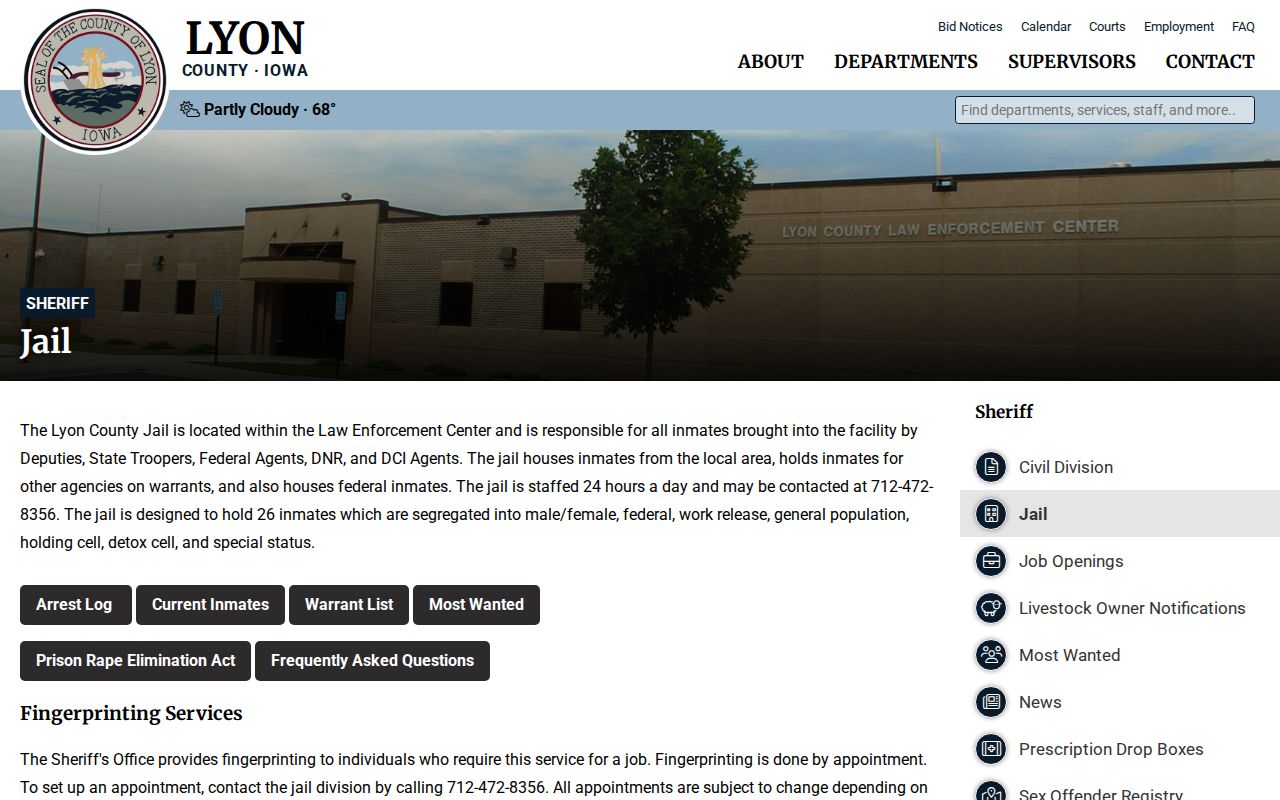
The jail page is the base channel for roster access, fingerprints, visitation rules, and the 24-hour facility phone.
Recent entries roll through these products as custody changes. An arrest may first appear in Arrest.pdf, remain in Current Inmates during detention, and later produce a court docket after County Attorney review. The exact intake-to-first-appearance deadline is not published on the jail page, so readers should not rely on an uncited local hour count.
Lyon County Multi-Agency Arrests
A state trooper arrest booked at the Lyon County Jail creates at least two custody trails. The jail can answer about booking and present confinement, but Iowa DPS owns the trooper's narrative report. The same rule applies to DNR conservation officers, DCI investigators, and federal agents. Requesting the story from the jail alone may yield only the short custody facts.
| Arresting agency | Lyon County role | Report route |
|---|---|---|
| Lyon County Sheriff | Primary local police and jail custodian | Sheriff counter, phone, fax, or chapter 22 request |
| Iowa State Patrol | Highway and state enforcement | Iowa DPS public-record channel |
| Iowa DNR | Natural-resource enforcement | Iowa DNR public-record channel |
| Iowa DCI | State investigations and repository work | Iowa DPS/DCI record channel |
| Federal agency | Federal investigation or hold | Originating agency or FOIA; PACER if charged |
Always identify the responding or arresting agency before sending a request. A Lyon County booking does not transfer ownership of an outside agency's investigative report.
Arrests Are Not Convictions
An arrest records police action and custody based on an allegation or warrant. It is not proof of guilt. The County Attorney may decline, replace, or amend a booking charge. A court may dismiss it, accept a plea, conduct a trial, enter a deferred judgment, acquit, or convict. Anyone checking a Lyon County arrest should find the matching court disposition before drawing a conclusion.
| Point | Arrest record | Conviction record |
|---|---|---|
| Created by | Arresting agency and jail | Iowa District Court and clerk |
| Shows | Police action, booking, alleged charges, and custody | A finding of guilt and resulting judgment |
| Local source | Sheriff products or originating agency report | Lyon County court docket and file |
| Possible end | Release, no filing, dismissal, or later restriction | Sentence, appeal, or qualifying expungement |
Note: A Lyon County arrest is an accusation and custody event, never proof that the person committed the alleged offense.
Lyon County Booking Charge Changes
Booking staff enter charges or holds as they are understood at intake. County Attorney Nolan McGowan's office becomes involved after the police stage and reviews what should be prosecuted. A filed count may differ from the short jail wording, and the court can later amend or dispose of it. The Lyon County criminal court case record is the better source for filed charges, pleas, judgment, and sentence.
Record flow: Arrest Report › Jail Booking › County Attorney Review › Court Filing › Disposition › DCI Update
When a stale arrest remains in a statewide check, compare it with the clerk's final disposition. DCI accepts disputes about a specific entry and may request fingerprints to confirm identity. Without a signed release, DCI withholds completed deferred judgments and arrests older than 18 months with no final disposition from a non-law-enforcement requester. That rule affects disclosure, not the historical fact that an event was reported. The official Sheriff news archive shows the public incident-release channel.
A news release can point to an event, but a focused request is still needed for the releasable narrative report.